For First-Time Non-Technical Founders
Turn Your App Idea Into a Developer-Ready MVP Scope.
Stop feature creep before paying developers. Define your core customer outcome and protect your build budget in one focused working day.
5-step workbook + MVP decision tools + developer-ready brief template
$49 one-time · was $97 · 30-day clarity guarantee
(a) The core problem
The Scope Boundary Deficit
Your idea is not the problem. An unbounded feature list is.
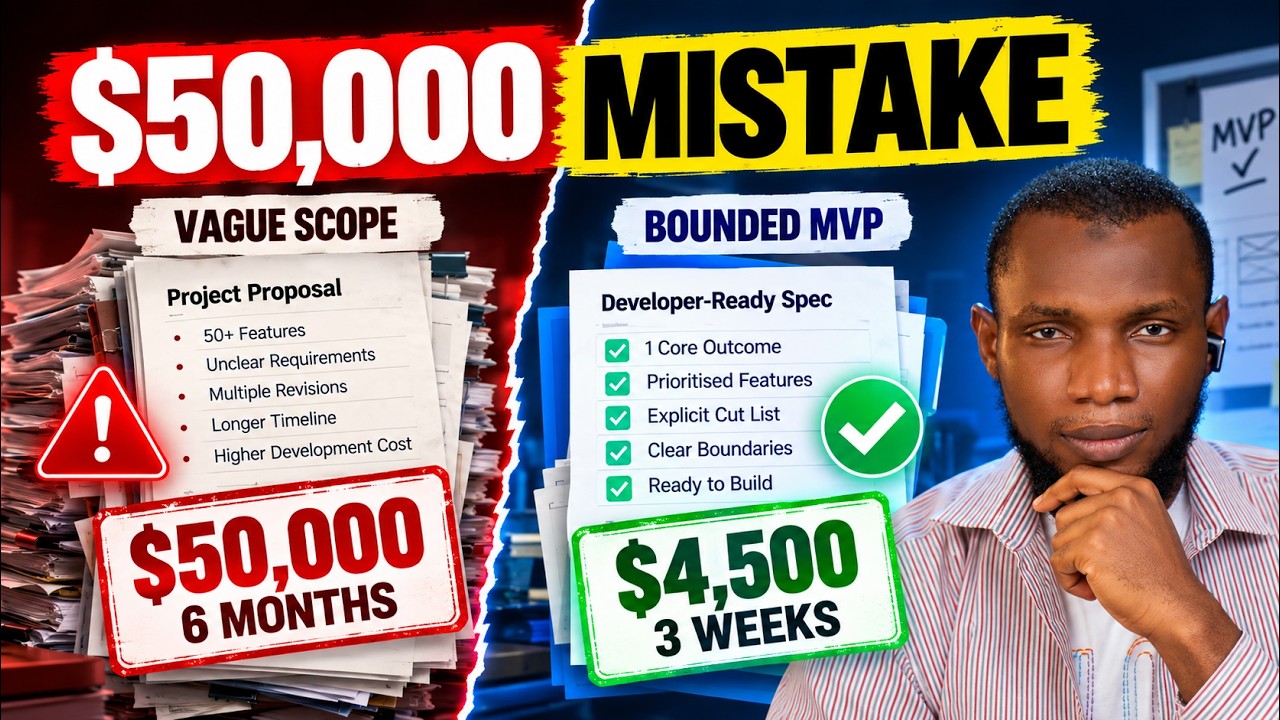
Quotes twice the budget
Months of notes turn into developer quotes that blow past your savings before a single screen ships — because the product is still an open bucket of ideas.
Feature packing feels safer
Every extra screen multiplies technical risk. You freeze, terrified that cutting anything will make version one look amateurish.
Guesswork burns capital
Generic docs never map software logic. Without hard boundaries on paper, developers guess — and that guesswork quietly delays launch for months.
(b) The opportunity
The Subtractive Scope Protocol
Walk into developer negotiations in command — fixed-scope quotes, protected savings, and a lean tool that funds itself.
- —Open-ended wishlist handed to an agency
- —Custom automation before demand exists
- —Quotes that drift because nothing is bounded
- —Months of build time, no validation
- ✓Airtight spec with visible exclusions
- ✓Manual workflows that validate on day one
- ✓Fixed-scope quotes with nothing to assume
- ✓Weeks to launch, near-zero technical risk
(c) Who this is for
Built for founders who must make technical decisions without being technical.
Non-Technical Corporate Professionals
You have deep domain knowledge and spotted an operational problem, but feel overwhelmed trying to translate business ideas into software requirements.
Domain Experts and Consultants
You want to turn your proven service framework into software, but fear wasting personal capital on unproven features developers might misunderstand.
Solo Business Owners
You need to launch a functional tool quickly to solve an operational bottleneck without burning your working capital on bloated engineering contracts.
(d) What you get
Cut the Scope Bloat and Hand Developers a Brief They Cannot Misunderstand
Eliminate Up to 50% of Unnecessary Build Costs
Strip out expensive custom features before paying a developer. Keep your money in your bank account instead of wasting it on code no user asked for.
Lock In Fixed-Price Quotes With Zero Guesswork
Hand technical teams an airtight blueprint that maps out every user action and edge case. Remove the ambiguity that agencies use to justify hourly rate increases.
Get Build-Ready in One Focused Working Day
Stop spending months rewriting messy notes and fifty-page documents. Walk away with an actionable, bounded specification in hours, not months.
Validate Demand Without Expensive Automation
Identify which background tasks you can handle manually on day one. Prove that real customers want the outcome before you spend a single dollar coding back-office workflows.
(e) In the field
Proven by Founders Who Refused to Waste Their Savings on Bad Code
I cut three months of development time and saved over $8,000 on my first quote. Developers finally understood what to build without any confusion.
This framework forced me to eliminate half my wishlist and focus on the one outcome that mattered. We launched on time and under budget.
(f) Origin
Why I Stopped Watching Good Founders Waste Money on Bad Product Scopes
I spent years working across software engineering, product management, and development teams. During that time, I watched smart, capable non-technical founders walk into agency meetings with pure excitement. They had clear domain knowledge and big visions sketched across dozens of pages.
Then the same disaster happened every single time.
Founders handed developers open-ended wishlists, thinking the engineers would tell them what belonged in version one. The agencies smiled, billed by the hour, and started coding without defined boundaries. Months passed. Budgets evaporated. The finished apps were slow, bloated, and confusing to real users. Watching good founders drain their personal savings on software that never launched made me furious. The industry treats product scoping like an afterthought, leaving non-technical builders entirely at the mercy of technical jargon.
The breaking point came when I saw an experienced professional spend nearly a year and tens of thousands of dollars rebuilding an app that could have been validated in a single weekend.
That was my wake-up call.
Founders do not have a building problem. They have an editing problem.
They do not need to learn full-stack code or read complex computer science textbooks. They need a systematic way to separate the primary customer outcome from attractive extras before signing any contracts.
I took the exact decision frameworks I used in engineering and stripped out all the corporate fluff. I built the Subtractive Scope Protocol and turned it into the MVP Scope System. Now, non-technical founders can sit down, draw strict perimeters around their ideas, and hand developers an unambiguous specification in a single day.
(g) How it works
The 5-Step Scope System
One focused day. Five decisions. A brief developers cannot misunderstand.
Define Your Core Customer Outcome
Isolate the single result your product must deliver on day one. You strip away secondary features so your software solves one clear problem customers actually pay to resolve.
Run the Subtractive Cut Filter
Filter every feature idea through binary decision grids into include, defer, or cut. You eliminate scope bloat immediately and prevent thousands of dollars in unnecessary custom code.
Map Manual Operations First
Identify complex workflows you can handle by hand during launch. You bypass expensive backend engineering until paying users prove that custom automation is actually required.
Lock System Boundaries
Draw an explicit perimeter around version one. You document an exact cut list and visible open decisions so contractors cannot silently expand your project scope or timeline.
Assemble the Developer-Ready Brief
Transfer your locked requirements into structured templates detailing system actors, behaviors, and edge cases. You walk into contractor calls fully prepared to secure fixed-scope quotes.
(h) The investment
Launch cohort pricing is limited to the first 100 founders.
Standard access returns to $97 once the cohort fills.
- ✓The full 5-step MVP Scope System workbook with lifetime digital access.
- ✓Practical scoping worksheets + Outcome Traceability Grids to filter feature ideas.
- ✓The Developer-Ready Brief template to map actors, behaviors, and edge cases.
- ✓Bonus 1: Developer Estimate Review Checklist to catch inflated agency quotes.
- ✓Bonus 2: The Manual-First Operations Playbook to avoid premature custom automation.
- ✓Bonus 3: Technical Brief Walkthrough Video showing real brief teardowns.
- ✓30-Day Developer-Ready Clarity Guarantee included with every purchase.
30-Day Developer-Ready Clarity Guarantee
Go through the five-step scoping workbook. Map your customer outcome, run the cut exercises, and complete your developer-ready brief template.
If you do not have total clarity on your version one boundaries, or if you do not feel fully prepared to hand your scope to a software developer within 30 days of purchase, send us your completed worksheets. We will refund 100 percent of your payment immediately.
Zero financial risk · full refund · keep the worksheets
(i) Two paths
Two Paths for Your Software Idea
Next month, you sit down with a software development team.
You do not feel nervous or out of your depth.
You hand over a clean, five-page brief.
Every button, user step, and boundary is written down in plain English.
The engineers review it, understand it immediately, and give you an accurate, fixed quote.
No guesswork. No bloated hourly rates. No awkward tech jargon.
You protect your savings.
You watch your version one launch on schedule, built strictly to solve one core problem for real customers.
You keep adding features to messy documents.
You reach out to agencies with an open-ended concept.
Six months from now, your budget is completely drained.
The app is still unfinished, packed with complex tools nobody asked for.
You have to tell your family why thousands of dollars vanished with nothing clickable to show for it.
Every day you wait to set hard boundaries is another day of wasted momentum. Draw the line before you pay developers to guess.
(j) Final concerns
Clear Answers to Your Final Concerns
What if my software idea is too unique for a step-by-step system?
Your industry knowledge is unique, but software architecture is not. Every working app relies on the same basic building blocks: users, specific actions, rules, and outcomes. The MVP Scope System does not change your core idea. It strips away unnecessary noise so engineers can actually understand and build what matters.
What if I cut a feature that my users end up needing?
Cutting a feature from version one does not mean throwing it away. It means protecting your product so you can survive launch. You place secondary ideas into a documented backlog. Once your first version proves customer demand, you use real cash flow to build those extra features.
Should I hire a developer first so they can tell me what is possible?
Developers build solutions, but they should not decide your business boundaries. When you approach a team without a locked scope, they have to guess what you want. That guesswork leads to bloated technical setups and runaway hourly fees. You must define the customer outcome and rules before anyone writes a single line of code.
I do not know technical jargon, so won't developers still confuse me?
Good developers do not want you to pretend to be an engineer. They need to know who uses the app, what action they take, and what outcome should happen. The Developer-Ready Brief maps your real-world logic into simple, clear instructions. You direct the project in plain English without feeling like an outsider.
What if I do not have enough time to work through this right now?
This system is designed to take you from a raw feature wishlist to a locked scope in one focused working day. A single day spent defining your boundaries now saves you three to six months of painful rebuilds later. It is the fastest way to stop overthinking and start building safely.
(k) Questions
Frequently Asked Questions
Do I need technical or coding knowledge to use this?+
No. The system uses plain language worksheets. You map user actions and system rules without writing code, so developers understand your exact requirements without technical confusion.
How long will it take to finish my developer-ready brief?+
Most founders finish within one focused working day. The five-step workbook guides you through each decision step, eliminating endless brainstorming and getting you ready for developer quotes quickly.
Won't cutting features make my app look incomplete to customers?+
No. Early users want one core problem solved reliably. Cutting extra features keeps your product simple, protects your savings, and prevents confusing people with half-built tools.
What if my software idea is completely unique?+
The decision rules work for any software model. Every app relies on actors, actions, system rules, and boundaries. The framework organizes your specific domain knowledge into a buildable specification.
What is included with my purchase?+
You receive the complete five-step scoping workbook, developer-ready brief template, and decision grids. You also get three bonuses covering developer quote reviews, manual operations, and walkthrough guides.
How does this lower my development costs?+
Developers add expensive buffer to their quotes when requirements are vague. Handing them an explicit brief with strict boundaries removes guesswork, stops scope creep, and secures accurate estimates.
How does the 30-day clarity guarantee work?+
Complete the workbook and developer brief. If you do not feel fully confident handing your scope to a developer within 30 days, submit your completed worksheets for a 100 percent refund.